Three engineering decisions that remove failure modes.
Together they eliminate the downtime drivers of severe service.
Cavity-free geometry
The ball is a C-shaped segment rather than a full sphere, so there is no pocket behind the ball or within the body where media can accumulate. This eliminates product build-up that hardens and jams the valve, and trapped cryogenic liquid that vaporises and over-pressurises the body. No venting hole is required.
NO TRAPPED MEDIADouble-eccentric, non-rubbing motion
The rotation axis is offset twice, producing a cam action: the ball lifts away from the seat for most of the 90° stroke and only contacts it at the final closing moment. With no continuous rubbing, seat wear and operating torque drop sharply.
LOW TORQUE · LONG LIFETorque-assisted metal-to-metal sealing
At close, applied torque drives the ball into the seat, generating mechanical sealing load independent of line pressure or temperature. The result is repeatable, bidirectional tight shut-off — and a small increase in closing torque restores tightness without disassembly.
BIDIRECTIONALSevere-service materials & coatings
The C-Ball architecture allows a fully uninterrupted HVOF coating on the ball surface, resisting abrasion and allowing the valve to close on entrained particles without damage. Seat and body materials are selected for the service, including NACE-compliant options.
HVOF · NACEIn-line maintainability
Top-entry construction gives access to all trim from above, so repair happens in-line. With a single static seat and no pre-loaded spring packs, no special hydraulic tooling is needed — reducing downtime and maintenance cost.
TOP-ENTRYC-Ball vs. conventional ball valve.
| Failure mode | Conventional ball valve | ANMAI C-Ball |
|---|---|---|
| Trapped media / cavity pressure | Risk present; needs vent | Cavity-free, no vent needed |
| Seat wear | Continuous rubbing | Non-rubbing cam motion |
| Sealing vs ΔP / temperature | Pressure-dependent | Torque-assisted, independent |
| Abrasive / particle media | Scores seats | Coated ball closes on particles |
| Maintenance | Often requires removal | Top-entry, in-line |
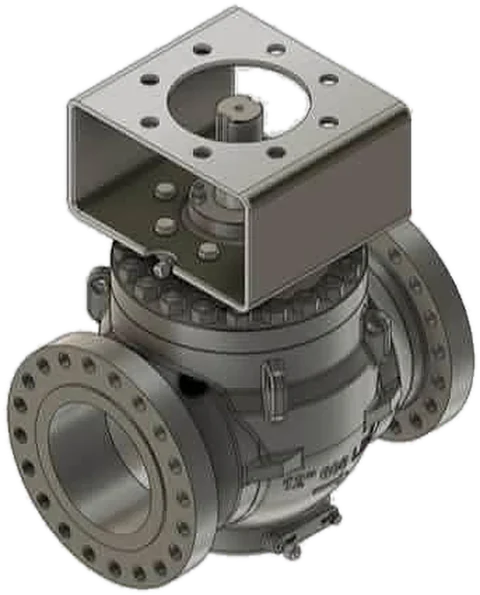
Technical envelope
| Sizes | DN15–DN600 (NPS ½–24) |
|---|---|
| Pressure | Class 150–1500 / PN10–250 |
| Temperature | −253 °C to +540 °C (by family) |
| Leakage | ANSI/FCI 70-2 Class V–VI |
| Standards | API 6D / 608, ISO 15848-1, BS 6364 |
Indicative envelope — confirm against the datasheet for your service.
See it applied to your service.
Browse the valve families engineered around these principles.
View products